Before You Click 'Add to Basket': The Quiet Case for the Local Fabric Showroom
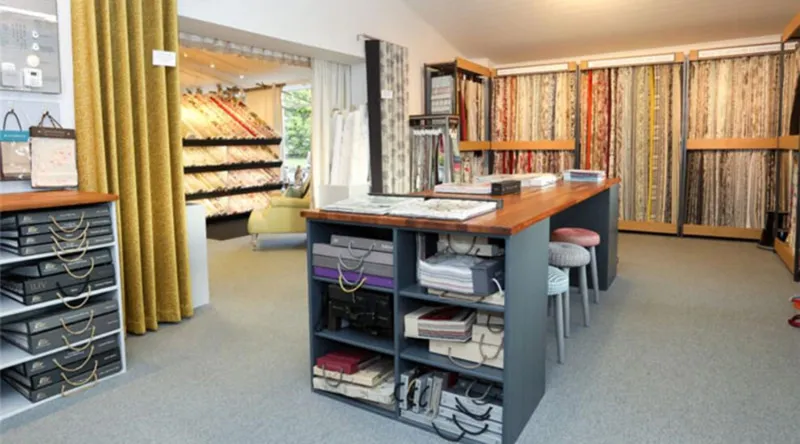
Photo: fabric showroom bolts of cloth interior design shop UK, via boutiquestoredesign.com
There is a particular kind of confidence that comes from holding a fabric before you buy it. No photograph, however expertly styled, can convey the weight of a heavy linen in the hand, the way a velvet drinks the light, or the true temperature of an oatmeal weave against a south-facing window. Yet increasingly, homeowners are asked to make significant decorating decisions — sometimes hundreds of pounds' worth — based on a thumbnail image and a hopeful imagination.
We would argue, politely but firmly, that this is a false economy.
Screens Lie About Colour
Every interior designer knows the frustration: a client falls in love with a terracotta online, only to discover on delivery that it is, in fact, closer to salmon. Screens render colour differently depending on calibration, ambient light and even the device in your hand. A fabric that reads as a soft dove grey on a laptop may reveal a distinct blue undertone in daylight.
In a showroom, you can carry the cloth to the window. You can see it in the same north light that falls across your own sitting room, hold it beside your existing sofa, and lay it against a paint chart from the same manufacturer you plan to use. Ten minutes of comparison saves weeks of returns and, more importantly, the lingering disappointment of a room that never quite came together.
Weight, Drape and Handfeel Cannot Be Downloaded
Fabric descriptions do their best — 'medium-weight', 'soft drape', 'generous width' — but these are matters of degree, and degree matters. A Roman blind in a crisp cotton behaves entirely differently from one in a slubbed linen. A curtain that pools beautifully on a showroom rail may hang stiffly at a shallow-width window.
The handfeel of a textile is the single best predictor of how it will live in your home: how it creases, how it catches the light through the day, how it feels when you draw it back each morning. This is knowledge you can only acquire by touch.
The Measuring Conversation
Perhaps the most undervalued part of shopping locally is the advice that comes free with it. Bay windows, sash reveals, awkward recesses and radiators tucked beneath sills — these are the everyday puzzles of British housing stock, and they rarely fit neatly into an online dropdown menu.
A seasoned consultant will ask the questions an algorithm never does. Which way does the window face? Is the blind for privacy, insulation, or simply dressing? Do you open the sash in summer? Will the fabric fade on a west-facing elevation? The answers change not only the recommendation but the making specification — where the blind sits, how it is lined, which side the mechanism serves.
Craft Is a Local Resource
Behind every made-to-measure blind is a machinist, a cutter, a fitter — skills that take years to develop and cannot be outsourced to a fulfilment centre. When you buy locally, you are sustaining a supply chain that lives within a few miles of your home: people who will still be there in five years when you need a matching blind for the extension, or a spare length of the same cloth for a cushion.
This is not nostalgia. It is a practical argument about accountability. A local business has its reputation on the high street, not buried in a reviews page. When something needs adjusting, there is someone to call who knows your window by name.
The Smarter Choice, Not the Sentimental One
We are not against the internet — we use it daily, and much of our inspiration-led browsing begins online. But for the decisions that shape how a home feels for a decade or more, the internet is a research tool, not a destination.
Visit the showroom first. Collect swatches, take them home, live with them for a week against your walls and your light. Then order with certainty rather than hope. That is not an old-fashioned way of shopping. It is simply the more intelligent one.