Sash, Bay and Bow: A Period Property's Guide to Beautifully Dressed Windows
Photo: Benh LIEU SONG, CC BY-SA 3.0, via Wikimedia Commons
There is an unmistakable romance to the windows of a period property. The slender glazing bars of a Georgian sash, the generous proportions of a Victorian bay, the pretty leaded lights of an Edwardian semi — these are architectural details that no modern building can convincingly imitate. Yet dressing them well requires a sensitive hand, for the wrong treatment can diminish precisely the character that makes such homes so beloved.
The guiding principle, honed over decades of working with Britain's older housing stock, is simple: the window is the protagonist; the dressing is its supporting cast.
The Georgian Eye: Symmetry, Restraint and Light
Georgian architecture is an exercise in proportion. Tall, narrow sash windows were designed to flood rooms with light and to present a harmonious face to the street, and any window treatment should defer to that geometry.
Fabrics with drape and gentle lustre — silks, fine cottons, subtle damasks — suit the era's innate formality. Pale blues, sage greens, stone and soft greys sit comfortably within a Georgian palette, as do the deeper, more pigment-rich shades of the later period.
For those wishing to honour the style authentically, a pelmet board with shaped pelmet frames the window head beautifully and conceals the workings of curtains or blinds beneath. Within the recess itself, a discreet Roman blind in a striped or small-scale patterned fabric allows the glazing bars to remain the focus — an ideal solution in rooms where curtains would overwhelm a modest wall.
The Victorian Stage: Layers, Fringes and Confidence
The Victorians approached window dressing with an enthusiasm bordering on the theatrical. Heavy draperies, swags, tails, tasselled tiebacks and layered blinds were the order of the day, and a bay window was quite deliberately a stage set for the parlour.
Few of us wish to live in a museum, but there is much to borrow. A pelmet with a decorative braid or fringe adds period character without demanding full drapery; curtains hung from a decorative pole with finials bring softness and a sense of occasion; and pairing full-length curtains with a Roman blind beneath delivers the layered look at a fraction of the Victorian labour.
Bay windows present their own practical puzzle. Curtains can be hung on a flexible or hinged bay pole so they traverse the angles cleanly, while individual blinds within each window section — Roman, roller or Venetian — offer precise control of light and privacy across a south-facing bay as the sun moves through the day.
The Edwardian Softening: Lightness and Craft
Edwardian interiors loosened the corsets of their Victorian predecessors. Windows grew wider, rooms brighter, and the preference shifted towards lighter fabrics, floral motifs and handcraft detailing — think muslins, lace panels, chintz and delicate embroidery.
This is a gift for the modern decorator. Voiles and lightweight sheers flatter Edwardian casement windows wonderfully, filtering light while preserving privacy in those close-knit suburban streets. Café-style shutters or blinds on a lower sash suit cottagey Edwardian kitchens and bathrooms, preserving light from above while screening the room from passers-by. Floral and botanical prints, so beloved of the era, remain abundantly available from today's fabric houses in fresh, contemporary colourways.
Old Windows, Modern Demands
However handsome, period windows can be draughty, temperamental and singularly un-private. Fortunately, today's window dressings solve these problems with quiet efficiency.
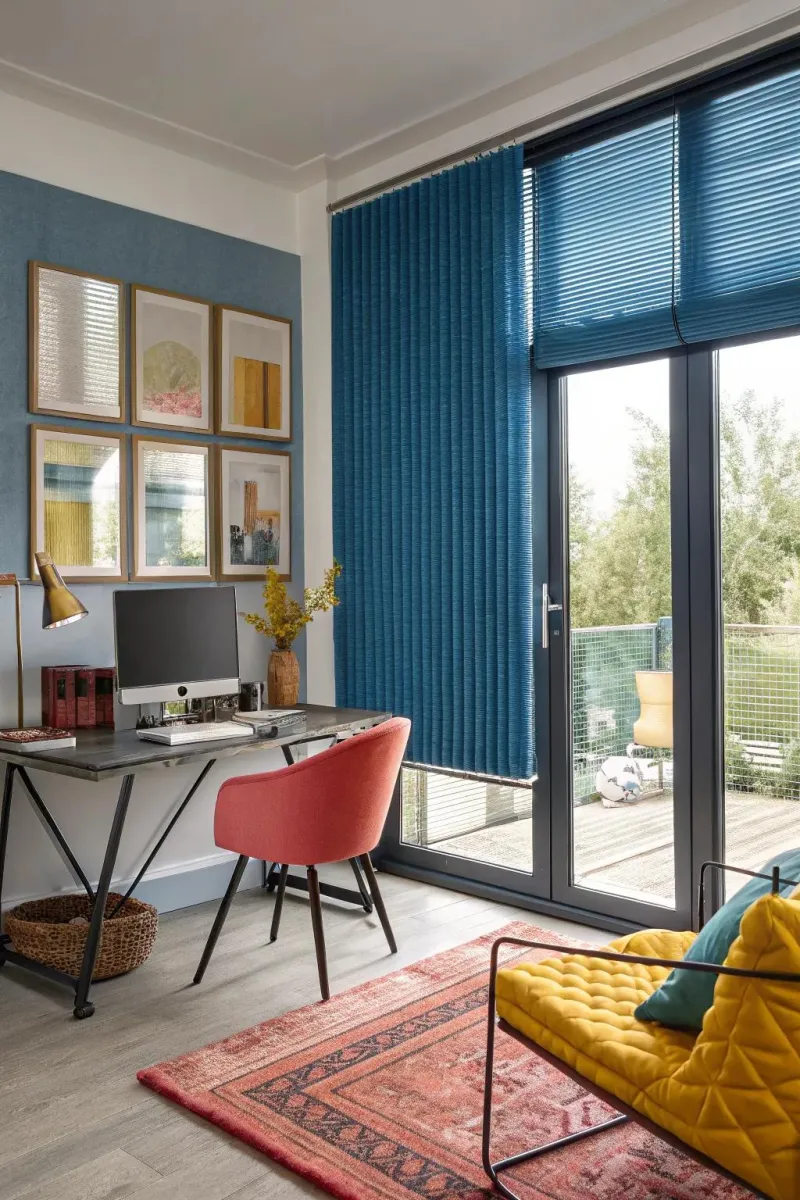
Insulation is the most pressing concern. Thermal-lined curtains and Roman blinds with thermal or blackout linings create a genuine barrier against heat loss — particularly valuable where original single-glazed sashes are retained, as they should be wherever planning and conscience allow. A well-fitted blind within the recess can reduce draughts noticeably, and layered treatments (blind plus curtains) perform best of all.
Privacy in Victorian terraces and Edwardian semis, where front rooms often sit close to the pavement, is easily achieved with top-down bottom-up blinds, voile layers, or café shutters that screen the lower half while admitting light from above.
Light control matters too: blackout linings in bedrooms, and in sun-facing rooms, fabrics with good colourfastness to prevent fading — always worth confirming with your fabric supplier before committing to a south-facing bay.
A Closing Thought
Period windows ask only one thing of us: that we work with their character rather than against it. Choose fabrics and styles that respect the proportions, the mouldings and the mouldings' neighbours — the picture rails, the ceiling roses, the plasterwork — and the result is a room that feels neither costume-drama nor coldly contemporary, but quietly, comfortably right.
Visit our showroom with photographs and measurements of your windows, and our team will happily talk you through the possibilities, swatch by swatch.