The Three-Metre Rule: How a Single Curtain Panel Can Reshape a Whole Room
Photo: Miscellaneous Items in High Demand, PPOC, Library of Congress, Public domain, via Wikimedia Commons
There is a quiet confidence to a well-dressed window. Stand back from it — really stand back, the way a designer does — and you begin to notice that the fabric is doing far more than covering glass. It is redrawing the architecture. A ceiling appears higher. A narrow window seems grander. A draughty corner softens into somewhere you actually want to sit.
We call it the three-metre rule: the observation that a single, generously proportioned curtain panel — hung wide, hung high, and chosen with intent — can transform the feel of an entire room. No extension, no replastering, no four-figure joinery bill. Just cloth, thoughtfully deployed.
Why One Panel Works Harder Than You Think
The instinct with curtains is often symmetry: two panels, one either side, meeting politely in the middle. It is tidy, and there is nothing wrong with tidy. But symmetry can also flatten a room, particularly in the many British homes where windows sit slightly off-centre, or where a chimney breast has already claimed the focal wall.
A single panel, hung to one side of a window or drawn across a glazed door, introduces what designers call asymmetrical balance. The eye travels along the fabric's fall, taking in the height and texture of the whole wall rather than the dimensions of the glass alone. In a Victorian terrace with a modest sash, or a 1930s semi with a slightly stingy picture window, this sleight of hand is invaluable. The window stops being the room's limitation and becomes part of a larger composition.
Hang High, Hang Wide: The Geometry of Generosity
The single most common mistake we see is curtains fitted to the window recess — a neat little frame of fabric that does nothing for the room around it. The remedy is almost embarrassingly simple.
Mount the track or pole fifteen to twenty centimetres above the window frame, ideally just below the ceiling line or cornice, and extend it twenty to thirty centimetres beyond the glass on each side. Suddenly the curtain, when open, frames the window rather than covering it — and because your eye reads the top of the drape as the top of the window, the whole aperture appears taller and wider.
In rooms with low ceilings — a cottage snug, an attic conversion, a flat in a converted warehouse where the beams dictate the proportions — this trick is close to magic. Full-length curtains in a linen blend or a softly textured weave draw the eye upward, and the ceiling seems to lift by a foot.
Heading and Drape: The Vocabulary of Shape
Not all folds fall alike, and this is where the character of a room is truly decided.
A pencil pleat is the dependable workhorse — casual, soft, forgiving. It suits relaxed living spaces and rooms where the fabric, not the formality, is the story. A double or triple pinch pleat carries more authority: the folds are structured, the stack-back is tidier, and the light falls in deliberate ridges. In a formal drawing room or a dining room used for occasions, pinch pleats lend a tailored confidence that flat, unstructured fabric cannot.
Then there is drape — the way cloth hangs and pools. A fabric with body, such as a heavy linen or a wool mix, will fall in deep, sculptural folds that add weight to a sparse room. Something lighter, like a cotton voile or sheer, will drift and move, softening a room that feels stiff or over-furnished. Choosing between the two is less about taste than diagnosis: what does the room lack, and what is the fabric being asked to supply?
The Lining Is the Luxury
Homeowners often spend their budget on the face fabric and treat lining as an afterthought. This is a false economy. The lining is where a curtain earns its keep.
A good blackout lining transforms a bedroom and, crucially, protects the face fabric from fading — a genuine consideration in a south-facing bay window in Brighton or a conservatory-adjacent room that catches the afternoon sun. A thermal lining adds a measurable layer of insulation to single-glazed sashes, those beautiful but draughty features so many period homes still carry. And an interlined curtain — fabric sandwiched over a soft bump cloth — produces that plush, substantial fall you see in hotel suites and country house hotels. It reads as expensive because it behaves expensively.
Before and After: Thinking in Reverse
If you are working to a modest budget, try assessing your room in reverse. Instead of asking "what curtains shall I buy?", ask "what do I want this room to feel like, and what is currently preventing it?"
- A cold, uninviting corner? A full-height panel in a warm-toned weave — terracotta, ochre, a deep moss — wraps the corner in colour and visually raises the temperature of the space.
- A window that feels too small or mean? Hang one panel generously beyond the frame, in a fabric that contrasts gently with the wall, and let the drape suggest a grander opening.
- A room that feels bare and echoey? Heavy, interlined curtains absorb sound as well as draughts, lending a hush that paint and furniture alone cannot achieve.
One metre of considered fabric, hung with intention, will outperform five metres hung without it. That is the three-metre rule in practice: it is not the quantity of cloth but the intelligence of its placement that reshapes a room.
See the Fall Before You Commit
Fabric is a material thing. Photographs flatten it; screens misjudge it. The way a linen falls, the depth of a pleat, the hand-feel of a wool mix — these are qualities you understand in seconds and cannot understand at all from a product page.
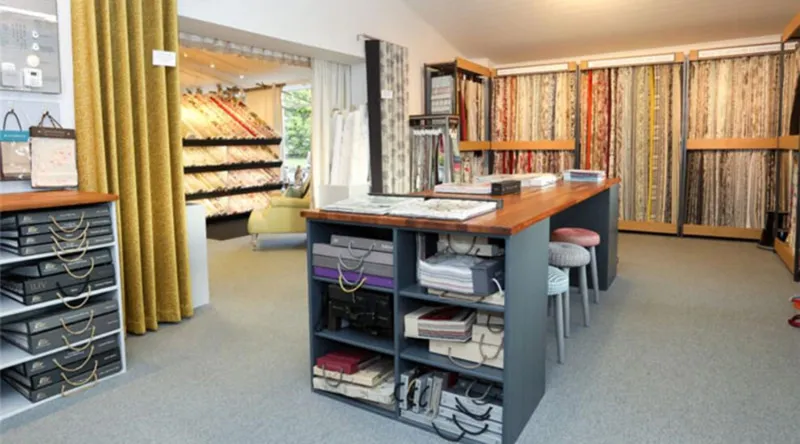
We would always encourage a visit to the showroom, lengths in hand if you have them, to see how a fabric drapes over the edge of a table before you commit it to a window. Bring your room's measurements and, ideally, a photograph. Sometimes the difference between a good curtain and a transformative one is a single conversation — and a slightly longer pole.